
A few days ago, I was helping a couple who were in the midst of a comprehensive renovation of a barn conversion. They were caught in a classic design tug-of-war. The structure of their home was ancient—exposed beams, rough stone walls—but their furniture and kitchen were aggressively modern, full of sleek lines and polished concrete.
They stood between our Beaumont (a quintessential traditional wood burning stove) and our Milan (a cylindrical, contemporary masterpiece), looking utterly lost.
“We want the efficiency,” the husband said, “but we don’t know if we should honour the building’s past or its future.”
This is a pivotal moment in any consultation. Clients often think they have to sacrifice performance for a traditional look, or warmth for a modern aesthetic. I sat them down to explain that at Chesneys, the “engine” inside is always cutting-edge; the choice is purely about the design language.
To help them—and perhaps to help you—we broke down the core differences between our Traditional and Modern collections.
The Traditional Aesthetic: Timeless Warmth
I walked them over to the traditional display. I pointed out that a stove like the Salisbury or the Alpine isn’t just a heater; it’s a piece of furniture that anchors a room.
- Design Cues: These stoves often feature cast iron detailing, corniced tops, and sturdy legs. They echo the architectural history of Georgian and Victorian Britain.
- The Feeling: They create a sense of “hearth and home.” Even when unlit, they add a layer of texture and history to the room.
- Innovation Hidden in Plain Sight: I emphasised that, despite the vintage look, these aren’t the dirty, inefficient stoves of the past. They are Ecodesign Ready, utilising clean-burn technology that re-ignites smoke particles before they leave the stove.
The Modern Aesthetic: Fire as Art
We then moved to the contemporary range. I showed them how models like the Shoreditch or Milan strip away the ornamentation to focus entirely on the flame.
- Design Cues: These stoves prioritise expansive glass windows, often offering a view of the fire and the surrounding landscape. They use high-grade steel to achieve tighter, cleaner lines that cast iron sometimes cannot.
- The Feeling: A modern stove feels architectural. It is less about “cosiness and more about “drama.”
- Efficiency: Just like their traditional cousins, they are incredibly efficient, but their shape often allows for different installation options, such as pedestal bases or wall-mounted designs.
Quick Comparison Guide
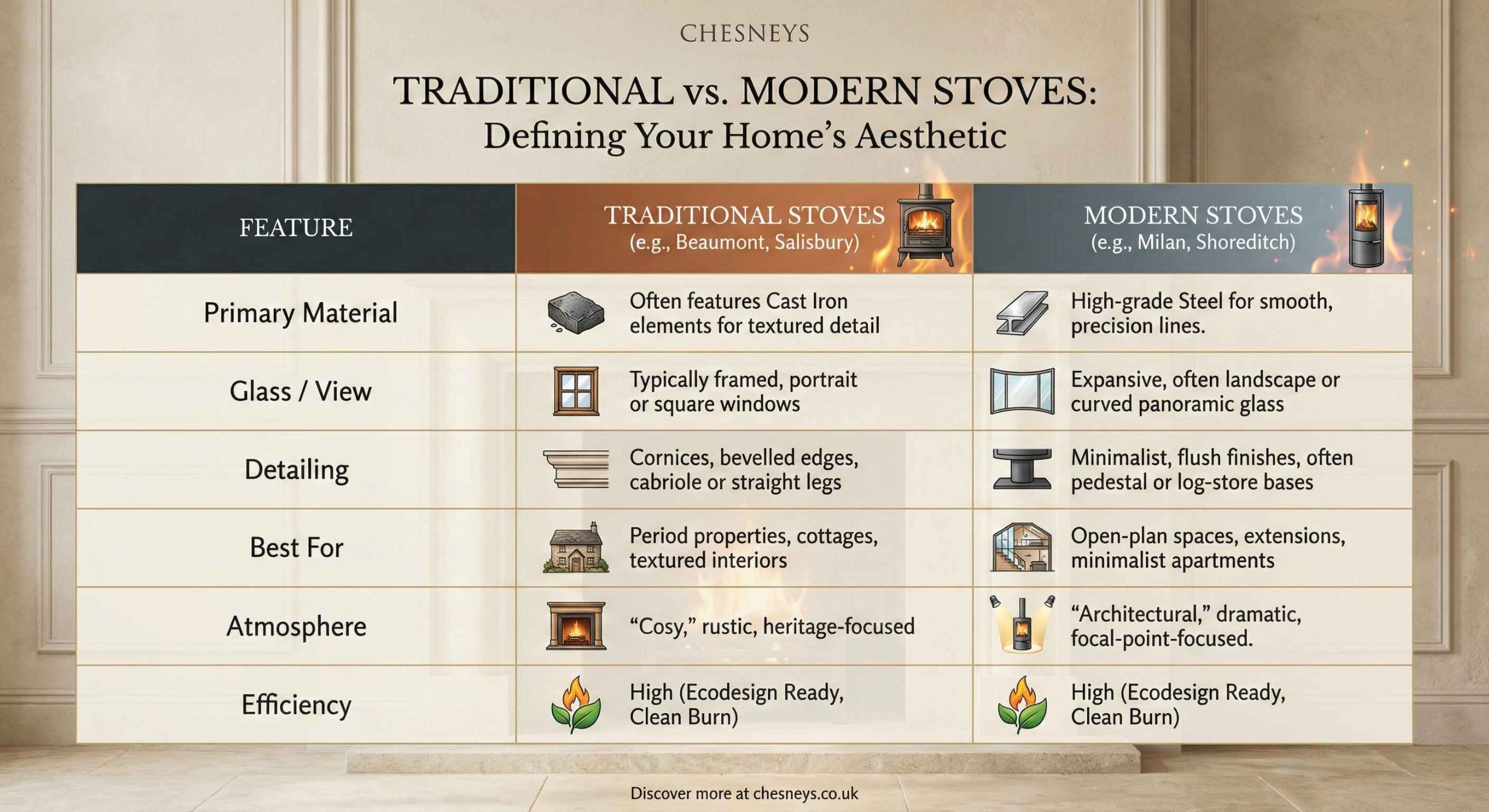
To make the decision easier, I sketched out a comparison for the couple. I often tell bloggers and interior designers that this table is the quickest way to determine which category a specific project fits into.
The couple looked at the table and then back at their barn plans. They realised that, because the efficiencies were identical (both offering over 80% compared to an open fire’s 20%), they were free to choose based on emotion.
They chose a Modern stove. Why? Because they wanted the fire to stand out against the old stone wall as a piece of living art, rather than blending in.
Whether you choose the heritage charm of a traditional stove or the sleek profile of a modern one, you are investing in the same industry-leading technology. The only question is: what story do you want your room to tell?